Prosthetics / Artificial Limbs
The Bionic Revolution: The Engineering behind myoelectric Limbs
Michael Duran
Introduction: Restoring Function with Bionic Limbs
What is myoelectric prosthesis ?
A Myoelectric Prosthesis is an advanced artificial limb controlled by electric signals generated from the user’s muscles. These bionic devices are engineered to detect these signals, translate them into movement, and deliver precise function to the user.
The core purpose of a myoelectric limb is to restore functionality and independence for individuals with limb loss. This technology allows amputees to perform complex, daily tasks with a level of control and dexterity previously unattainable by purely mechanical devices.
Key Terms to Understand
Prosthesis :An artificial device that replaces a missing body part
Myoelectric : relating to the electrical signals produced by muscle contraction
Amputee: An individual who has has had a limb removed
Brief History of Prosthetics
3000 BCE: Ancient Egyptians created the first wooden and leather prosthetic toes.
1500s: Ambroise Paré designs mechanical jointed prosthetic hands and legs.
World Wars I & II: Mass production of prosthetics improves fit and durability.
1960s: First myoelectric arms developed in Russia and introduced globally.
2000s–Present: Advanced sensors, AI, 3D printing, and neural interfaces transform prosthetic function.
How Myoelectric Limbs Work
Muscle Activation
The user contracts residual muscles in the upper arm or forearm.
EMG Sensors Detect Signals
Electrodes capture the electrical activity (EMG – electromyography) through the skin.
Signal Processing
The prosthetic interprets the signals using microprocessors and filters out noise.
Motor Control
Tiny electric motors generate movement based on the user’s intended action.
Feedback Loop
Some advanced models provide haptic or pressure feedback to improve control.
Components of a Myoelectric Prosthetic Limb
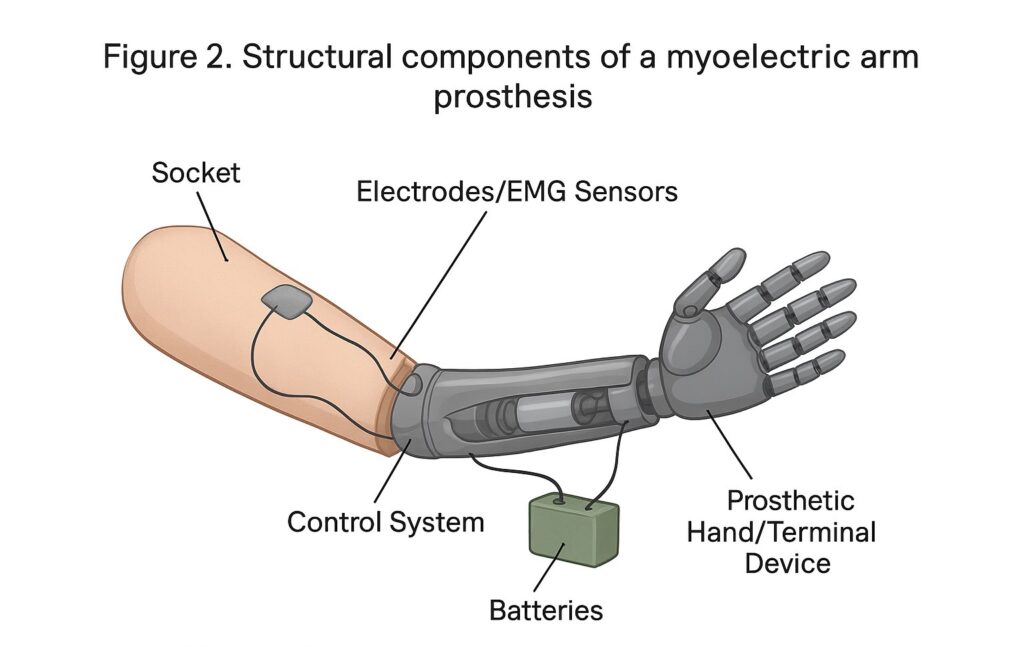
Figure 2. Myoelectric electrode placement.
Source: Ottobock Prosthetics (2022).
- Socket – Custom-fitted interface between the limb and user.
- Electrodes/EMG Sensors – Detect muscle signals.
- Control System – Microprocessors that interpret signals.
- Batteries – Rechargeable power source.
- Motors & Actuators – Generate finger, wrist, or elbow movement.
- Prosthetic Hand/Terminal Device – Grips, rotates, or pinches as commanded.
Advantages of Myoelectric Prosthetics
- More natural movement compared to body-powered devices.
- Higher grip variety (pinch, lateral, power grip).
- Improved aesthetics (no harnesses or cables).
- Greater Independence – A child with a below-elbow amputation can tie their shoes, open a backpack, and eat lunch on their own using precise pinching and gripping motions — tasks that previously required help from parents or teachers.
- More Realistic Daily-Use Benefit – Adults in the workplace can type, lift light objects, or hold tools without depending heavily on coworkers, increasing both independence and job performance.
Limitations & Challenges
- High cost.
- Battery dependence.
- Sweat interfering with sensors.
- Limited sensory feedback.
- Requires training and ongoing adjustments.
Practical Challenges from Real-Life Scenarios
- Environmental limitations – In humid or wet conditions, sensors may malfunction, reducing control.
- Physical fatigue – Users may experience muscle tiredness from repeatedly activating residual muscles.
Future Solutions & Innovations
- Lower-cost 3D-printed prosthetic shells.
- Longer-lasting batteries & wireless charging.
- AI systems that filter noisy muscle signals.
- Sensory feedback using haptic sensors.
- Neural interfaces that respond faster.
Realistic Future Improvements
- Sweat-resistant electrodes to improve reliability in daily activities.
- Self-calibrating signal processors that automatically adjust to the user’s muscle patterns.
Key people
Ambroise Paré (1510–1590)
He is considered the father of modern prosthetics because he created the first realistic, jointed artificial hands and legs.
He designed some of the first mechanical prosthetic limbs with moving joints.
His work helped turn prosthetics from simple wooden replacements into functional, movable devices.
FAQ’S
How does a myoelectric hand know what movement I want to make?
Sensors detect specific muscle patterns, and the processor maps those patterns to programmed movements.
How long do batteries last?
Usually 8–24 hours depending on use and model.
Do myoelectric limbs feel natural?
Movement is highly functional, but sensation is still limited unless advanced feedback systems are used.
References
Ku I, Lee GK, Park CY, Jeong E. (2019). Clinical outcomes of a low-cost single-channel myoelectric-interface 3D-printed hand prosthesis. Archives of Plastic Surgery. https://pubmed.ncbi.nlm.nih.gov/31336417/
(N.D)“Design and Development of an EMG Upper Limb Controlled Prosthesis: A Preliminary Approach.” (2024). — MDPI article on EMG-controlled prosthetic hand.https://www.mdpi.com/2076-0825/14/5/219?utm_source=chatgpt.com
(N.D)“The Reality of Myoelectric Prostheses: Understanding What Makes These Devices Difficult for Some Users to Control.” Frontiers in Neuroscience / Biorobotics (2016). https://www.frontiersin.org/journals/neurorobotics/articles/10.3389/fnbot.2016.00007/full?utm_source=chatgpt.com
(Purushothaman Geethanjali )“Myoelectric control of prosthetic hands: a state-of-the-art review.” PubMed article (2016).https://pubmed.ncbi.nlm.nih.gov/27555799/
(Maxwell Salazar,Paula Portero)“Review of Robotic Prostheses Manufactured with 3D Printing: Advances, Challenges, and Future Perspectives.” Applied Sciences (2023). https://www.mdpi.com/2076-3417/15/3/1350?utm_source=chatgpt.com
(JackTchimino)“EMG feedback improves grasping of compliant objects using a myoelectric prosthesis.” Journal of NeuroEngineering and Rehabilitation (2023). https://link.springer.com/article/10.1186/s12984-023-01237-1
Paré, Ambroise. Pare and Prosthetics: The Early History of Artificial Limbs. 1575 (reprinted in modern editions). As discussed in “Paré and Prosthetics: The Early History of Artificial Limbs,” by Alan J. Thurston, ANZ Journal of Surgery, vol. 77, no. 12, 2007, pp. 1114–1119.

